Magnetic Perfume Boxes: Magnet Types, Construction and Tolerance
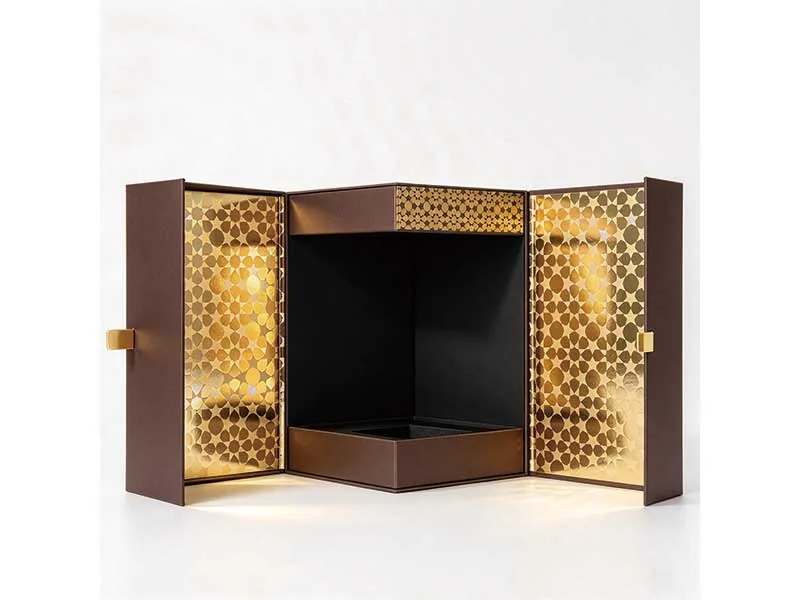
Most magnetic box problems trace to one of those three being decided in isolation. A magnet chosen for “strong” pull tears the wrap when the customer opens the box. A board that is too light warps after wrapping, so the lid no longer sits flush. A lid built to a nominal dimension rather than a clearance range binds in humid weather. This guide covers all three, and explains how to specify each one so the sample you approve is the box you receive in production.
The short answer
A magnetic perfume box is a rigid greyboard box — commonly 1200 gsm (~2.0 mm) for boxes under 150 mm, stepping to 1500 gsm (~2.5 mm) and 1800 gsm (~3.0 mm) as size and load increase — wrapped in printed paper, with neodymium disc magnets buried between the board and the wrap so both lid and base attract at the same point. Specify the magnet by grade, diameter, thickness and pull force in kilograms, measured at a stated air gap — not by the word “strong”. Lid fit should be given as a clearance range, not a single dimension.
1. Why the closure carries so much of the perceived value
A fragrance box is judged twice: once by eye on the shelf, and once by hand at the moment of opening. The magnetic closure is almost entirely a hand judgement. It is the first physical feedback a buyer gets about whether the brand is careful.
That is why the closure deserves a specification rather than a gesture. Three things have to be right at once:
- The pull has to be present but not stubborn. Too weak and the lid swings open in a bag. Too strong and the customer has to tug, the wrap creases, and the box feels cheap for the opposite reason.
- The lid has to sit flush. A magnetic closure that closes but leaves a visible gap reads as a manufacturing defect, even when the print is perfect.
- The box has to survive transit. A drop test is where magnetic closures really earn their place — or fail and let the lid pop open in the parcel.
Everything else in this guide is in service of those three outcomes.
2. What is actually inside a magnetic rigid box
A rigid magnetic box is a laminated structure, and each layer is an independent cost and quality decision. Understanding the stack explains most of the behaviour you will see in a sample.
| Layer | What it is | What it decides |
|---|---|---|
| Greyboard core | Recycled paperboard, the structural body | How solid the box feels; whether it warps |
| Magnet cavity | A pocket cut or drilled into the board | Where the magnet sits and how thick the cover over it can be |
| Neodymium magnet | Buried between board and wrap, in lid and base | How firmly the box holds shut |
| Wrap paper | Printed and laminated paper glued over the board | Print quality, scuff resistance, and whether the magnet shows through |
| Insert | Die-cut tray, EVA foam, pulp or dividers | How the bottle sits and how much shock reaches the glass |
The important consequence is that the magnet is not on the surface. It is hidden, and that hidden placement is exactly what creates the main engineering problem: the magnet has to pull through the board and the wrap. Every tenth of a millimetre of material between the magnet and the mating surface reduces the force that reaches the customer’s hand.
3. Board specification: greyboard weight is not thickness
The single most common specification error in rigid boxes is treating GSM as a thickness. GSM is grams per square metre — mass per area, not millimetres. Two boards of the same GSM from different mills, or of different density and grade, can measure different thicknesses. Always ask for both the gsm and the measured thickness.
| Greyboard | Approximate thickness | Typical use in fragrance | What to check |
|---|---|---|---|
| 1200 gsm | about 2.0 mm | Boxes under roughly 150 mm — single-bottle, sample sets, small gift boxes | Edge stiffness and warp after wrapping |
| 1500 gsm | about 2.5 mm | Mid-size gift sets and PR boxes, roughly 150–250 mm | Panel span and load |
| 1800 gsm | about 3.0 mm | Boxes over roughly 250 mm, or where the packed weight exceeds about 1 kg | Panel span and load; magnet depth grows with board |
Thicknesses are nominal starting points, not guaranteed values; board density and grade also affect stiffness. Confirm the measured thickness on your own sample.
Why the board choice sets the magnet specification
Board thickness is not only a rigidity decision — it is a magnetic one. The magnet sits in a cavity in the board, and the material left between the magnet face and the mating surface is what the force has to travel through. Go from 1200 gsm to 1800 gsm and you add roughly a millimetre of board to the magnetic gap on each side. The same magnet that felt right on the thin box may feel noticeably weaker on the thick one.
This is also why a heavier box is not automatically a better one. Above the point where the structure is already rigid enough for the contents, extra board buys weight in the hand but costs magnet performance and shipping weight.

1200 gsm grey board with matte lamination and gold foil — the standard build for single-bottle fragrance boxes.
4. Magnet specification: grade, size, coating and pull force
Fragrance gift boxes use sintered neodymium-iron-boron (NdFeB) magnets, not ferrite and not magnetic sheet. Neodymium gives far more force per millimetre of thickness, which matters because the magnet has to hide inside a board cavity without telegraphing through the wrap. Ferrite is cheaper but needs to be much larger and thicker for the same hold, and flexible magnetic sheet is too weak for a lid that has to stay shut in a bag.
What the grade number means
The grade — N35, N42, N52 — is the maximum energy product, a measure of how much magnetic energy the material stores per unit volume. A higher number means a stronger magnet of the same size. Two practical consequences:
- A higher grade lets you use a thinner or smaller magnet for the same pull — useful when the box cavity is shallow.
- Higher grades are more expensive and, in general, more brittle. Moving from N35 to N52 does not automatically make the closure feel better; it makes it easier to fit force into a small space.
Size and shape
Discs are the default in rigid boxes because a round cavity is easy to cut and the force is concentrated at a point. Diameters in the region of 8–15 mm and thicknesses of about 1.5–2 mm are the usual working range for fragrance boxes — small enough to hide, thick enough to hold. Rectangular magnets are used where the cavity is shallow and wide, or where a longer hold line is wanted.
Coating
Bare NdFeB corrodes quickly, so all box magnets are coated. Nickel-copper-nickel (NiCuNi) plating is the standard. Epoxy coating is the better choice for humid climates and long sea transit, and for fragrance specifically it is worth noting that a coated magnet is also a barrier between the magnet alloy and the product environment.
How to specify pull force so the sample matches production
This is where most buyers get caught. “Strong magnet” is not a specification, and pull force figures are not comparable unless the measurement conditions are stated. Three variables change the number completely:
| Variable | Why it changes the number | What to write on the drawing |
|---|---|---|
| What the magnet is pulling against | Magnet-to-steel and magnet-to-magnet give different results | State which pairing is used in your box |
| Air gap | Force falls off very quickly as the gap grows — board and wrap thickness are part of the gap | State the measured gap between magnet faces |
| Test method | Fixtures, pull speed and whether the value is a peak or a holding force differ by supplier | Ask for the method, not just the number |
5. How magnets are installed — and why polarity matters
In a hidden-magnet box the magnet is dropped into a cavity cut into the greyboard, glued or encapsulated, and then covered by the wrap. The sequence matters: the magnet has to be positioned before the wrap goes on, because after wrapping the position is locked and cannot be corrected.
Three things go wrong in installation:
- Polarity. Every magnet has a north and a south face. The lid magnet and the base magnet must face each other with opposite poles, or the box repels instead of closing. On a two-magnet-per-box design this is the first thing to check on a sample, and the first thing to check on a production lot.
- Alignment. The lid and base cavities have to line up when the box is closed. Misalignment is invisible when the box is open and obvious when it shuts — the lid shifts sideways until the magnets find each other, and the gaps become uneven.
- Depth and encapsulation. Neodymium is brittle and cracks under impact or point pressure. If the magnet is not fully supported by the board cavity and adhesive, it can crack during assembly or in transit, and a cracked magnet loses most of its force.
Magnet plus steel plate, or magnet plus magnet?
Both are used. A magnet-to-magnet pair gives a strong, symmetric hold and is the usual choice for a book-style or flap lid where the two halves meet face to face. A magnet-to-steel arrangement puts a steel plate in one half, which can be cheaper and thinner on that side, and is common where one side has no space for a magnet cavity. The trade-off is that the closure force is less symmetric and the steel plate has to be positioned as precisely as a magnet.
6. Six reasons magnetic closures fail in the field
| Failure | What the customer sees | Root cause |
|---|---|---|
| Too weak | Lid opens in a bag or in transit; box feels cheap | Magnet grade/size too low, or too much board and wrap between magnet and mating face |
| Too strong | Customer tugs, wrap creases, print marks at the pull point | Oversized magnet chosen to be “safe” without testing the opening experience |
| Reversed polarity | Lid repels and will not stay shut at all | Polarity not checked on the assembly line or on the production lot |
| Lid warp | Magnetic closure shuts but leaves a visible gap at one corner | Board too light for the panel span, or wrap tension uneven; humidity makes it worse |
| Magnet migration or cracking | Closure weakens over time or is weak on some units only | Cavity too loose, insufficient adhesive, brittle magnet struck during assembly |
| Corrosion | Rust staining through the wrap on a small percentage of units | Uncoated or thinly coated magnet in a humid climate or long sea freight |
Notice that four of the six are specification or process failures, not material failures. They are prevented on the drawing and on the incoming inspection sheet, not discovered by the customer.
7. Tolerance and lid fit: why a single dimension is a trap
A rigid box lid cannot be specified as one number, because it is built from board that has a thickness tolerance, wrapped in paper that adds thickness unevenly, and assembled by hand. Lid fit has to be expressed as a clearance range — the gap between lid and base — with an acceptable minimum and maximum.
Too tight and the lid binds: it goes on but does not come off smoothly, and in humid weather it may not close at all. Too loose and the lid rattles, the gaps are visible, and the magnetic alignment shifts because the lid can move before the magnets engage.
Practical consequences for the drawing:
- Specify lid-to-base clearance as a range, and say which corner it is measured at.
- Give the box outer dimensions and the internal cavity dimensions, because the insert is cut to the inside.
- State the board grade and the wrap weight, since both change the finished thickness.
- Accept that ±1 mm on a finished rigid box is normal engineering tolerance, and design the insert with clearance accordingly rather than demanding a tolerance the process cannot hold.
Humidity is the variable that catches brands shipping into tropical markets. Paperboard absorbs moisture and expands; a lid that fits perfectly in a Shenzhen winter can bind in a Singapore warehouse. If the destination is humid, specify the fit slightly looser than you would for a European winter delivery, and confirm with a sample that has been conditioned.
8. Transit testing a magnetic closure
A magnetic box has a specific transit risk that ordinary rigid boxes do not: the magnets are the only thing keeping the box shut. Corrugated shippers protect the outside; nothing protects the closure except the magnet.
The test that matters is a parcel-level simulation — ISTA 3A is the common standard for e-commerce parcels — followed by an inspection of every unit for:
- Lid open or ajar on any unit
- Visible gap at the magnetic edge that was not there before the test
- Creasing or delamination at the wrap over the magnet cavity
- Shifted insert, or the bottle contacting the box wall
- Magnet rattling inside the board (a sign the cavity has opened up)
If the lid opens in transit, the fix is not automatically “a stronger magnet”. Check first whether the box is under-filled — a bottle that can move inside will transfer its momentum to the lid. An insert that holds the product firmly often solves a closure problem more cheaply than changing the magnet.

A die-cut EVA tray holds the bottle dead still — which also protects the closure, because nothing moves inside.
9. Cost drivers and minimum order quantity
Magnetic boxes are the most expensive common rigid structure, and the cost is dominated by hand assembly rather than material. What moves the price:
| Cost driver | Effect | How to control it |
|---|---|---|
| Board weight | Moderate — more material, more shipping weight | Use the lightest board that is rigid enough for the panel span |
| Magnet grade and count | Moderate — grade and size both scale cost | One well-placed pair per box; test the opening before increasing grade |
| Wrap material and finish | High — foil, emboss, soft-touch all add tooling and process steps | One foil or emboss detail on a matte-laminated wrap |
| Hand assembly | High — wrapping, magnet insertion, insert fitting are manual | Simplify the structure; fewer components |
| Insert type | Medium to high — foam and moulded pulp need tooling | Paper tray where protection allows |
| Order quantity | High — dies, plates and make-ready are fixed costs | Use one structure across several scents |
On quantity, magnetic rigid boxes generally need a larger run than folding cartons to be economic, because the set-up is heavier. Expect a materially higher unit price below a few hundred pieces, with the price settling once the run covers tooling and make-ready. If your launch quantity is small, the practical route is a folding carton for the first run and a magnetic box for the hero SKU, rather than accepting a poor unit price on a small rigid order.
10. The magnetic box specification checklist
Send this to the supplier with your enquiry, and require the same document back confirmed against your drawing revision.
| Item | What to state |
|---|---|
| Box outer dimensions and internal cavity dimensions | Both, in mm, with the measuring convention |
| Board grade and measured thickness | Gsm and the measured mm you expect |
| Wrap material and weight | Coated art paper weight, textured, kraft or fabric |
| Lid fit | Clearance range, not a nominal figure |
| Magnet grade, size and coating | e.g. N42 disc Ø10 × 2 mm, NiCuNi |
| Magnet count and configuration | Magnet-to-magnet or magnet-to-steel; one pair or two |
| Pull force and test method | Value in kg, with air gap and fixture stated |
| Polarity check | Confirm it is checked on the line and on each lot |
| Wrap over magnet cavity | That the magnet does not telegraph through the wrap |
| Insert type and cavity dimensions | Material and cavity sizes |
| Transit test | e.g. ISTA 3A, plus the post-test inspection list |
| Finishing | Foil, emboss, spot UV, lamination, with tooling cost stated separately |
When the supplier and the insert maker both work from one confirmed revision, the sample round becomes a confirmation rather than a negotiation. That is the whole return on specifying the closure before approving the artwork.
For the product-level view of what these boxes look like built around a real flacon, see our custom magnetic perfume box and bottle set, the magnetic box range, the paper tube and bottle set, and the wider custom perfume box structures. If you are deciding between structures, the lid and base and drawer box formats are the two closest alternatives.
Frequently Asked Questions
Sintered neodymium (NdFeB), usually in the N35 to N52 range. The number is the maximum energy product — a higher grade gives more force from the same size, which matters when the magnet has to hide in a shallow board cavity. Higher grades cost more and are generally more brittle, so the right grade is the one that meets the pull force at the available depth.
Commonly 1200 gsm (about 2.0 mm) for boxes under roughly 150 mm, 1500 gsm (about 2.5 mm) for mid-size sets, and 1800 gsm (about 3.0 mm) for boxes over about 250 mm or heavier contents. GSM is mass per area, not thickness — always confirm the measured thickness on your sample.
Almost always because something changed the magnetic gap or the magnet depth. A heavier board, a thicker wrap, a shallower cavity or a different magnet coating all reduce the force that reaches the lid. The grade can be identical and the closure still feel different. Specify the pull force measured at a stated air gap, so any change in the build shows up as a measurable difference.
Yes — that is reversed polarity. Each magnet has a north and a south face, and the lid and base magnets must present opposite poles to each other. It is not visible when the box is open, so it has to be checked on a sample and again on each production lot.
They behave differently and are not interchangeable specifications. A magnet-to-magnet pair gives a symmetric hold and is usual for flap and book-style lids. A magnet-to-steel arrangement can be thinner on one side and is common where space is tight, but the steel plate must be positioned as precisely as a magnet, and the published pull force is normally measured magnet-to-steel — so the two numbers are not comparable.
First check whether the product can move inside the box. A loose bottle transfers its momentum to the lid, and a firmer insert often solves it more cheaply than a stronger magnet. Then run a parcel-level simulation (ISTA 3A is typical) and inspect for lids ajar, uneven gaps and creasing at the magnet edge. Only increase magnet strength once the contents are held still.
Two things change in humidity: the board absorbs moisture and can warp, which affects lid fit, and bare neodymium corrodes. Use a coated magnet — NiCuNi is standard, epoxy is better for long sea transit and tropical destinations — and specify a slightly looser lid fit for humid markets, confirmed on a conditioned sample.
Magnetic rigid boxes need a larger run than folding cartons to absorb the heavier set-up of dies, plates and hand assembly, and the unit price is materially higher below a few hundred pieces. If your launch volume is small, a common approach is a folding carton for the first run and a magnetic box reserved for the hero SKU.