Perfume Bottle Neck Sizes and Crimp Specifications: The Complete FEA and GPI Guide
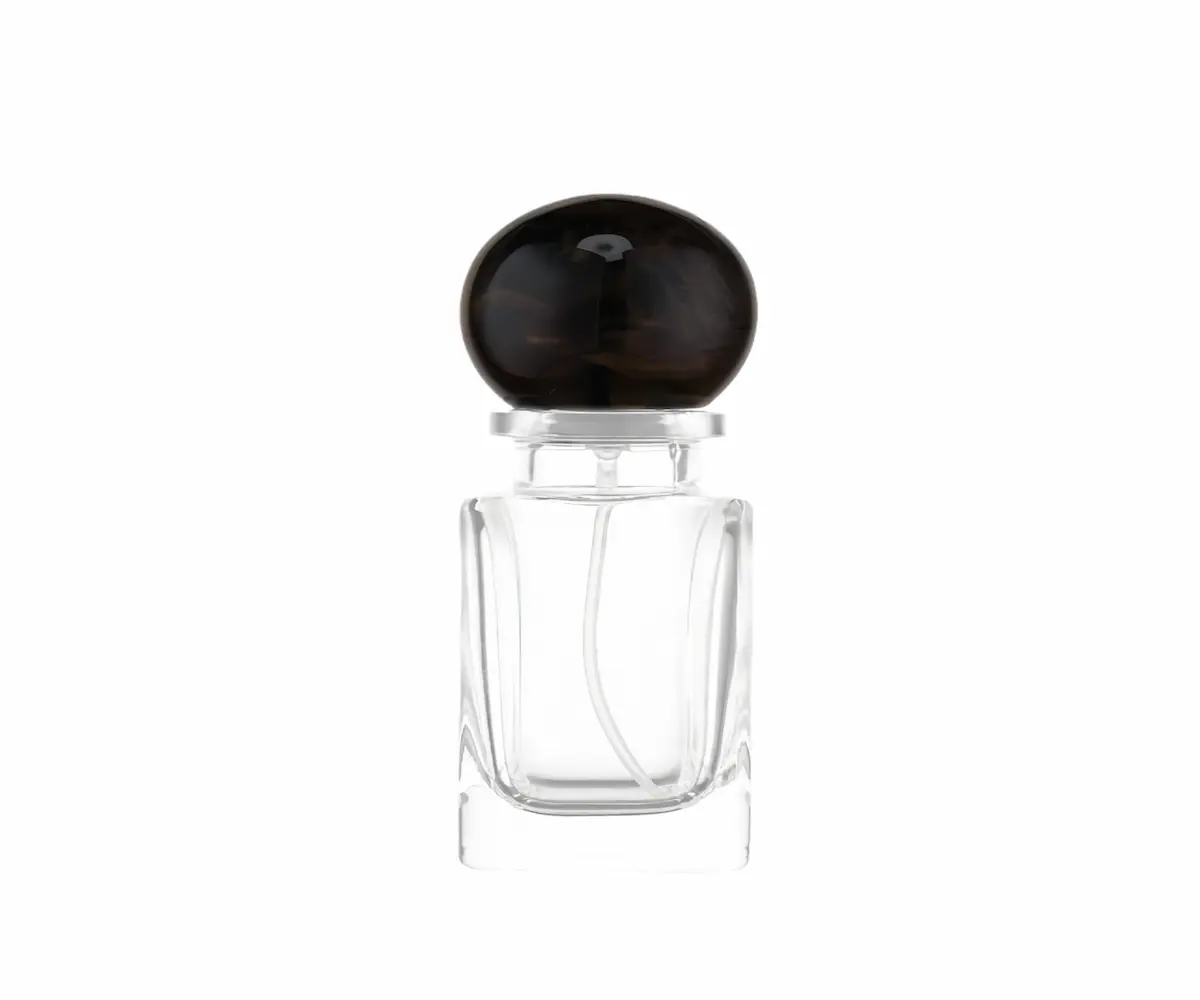
Say “15 mm neck” to five people in the fragrance supply chain and you may be describing six different specifications: FEA 15, a crimp neck defined in EN 14854; 15/415, a GPI screw thread; CV 15, a Cetie screw finish for screw pumps; the newer hybrid finishes SNI 15 and CNI 15; or the bore — a different dimension from the one the closure grips. None of these are interchangeable.
This guide untangles that: where the real standards live, what the letter codes mean (most articles get one wrong), how crimp and screw closures differ mechanically, and how to measure a neck so it can be specified rather than guessed. It is aimed at the moment these decisions stop being reversible — the signature on the glass drawing.
The short answer
A perfume bottle neck is specified by its neck finish — the geometry where the closure seals — not by a single diameter. FEA sizes (11, 13, 15, 17, 18, 20 mm) are trade names for the crimp necks standardised in EN 14854, where an aluminium collar is crimped over a glass bead. GPI finishes such as 15/415 are screw threads, where a liner seals and the thread only supplies compression. Bottle volume does not determine the neck.
1. “15 mm” is at least six different specifications
Most compatibility failures start with a number that looks specific but is not. Here is what “15 mm” can legitimately mean:
| What “15 mm” might mean | Family | What the closure does | Governed by |
|---|---|---|---|
| FEA 15 | Crimp neck, no thread, with a bead | Aluminium collar crimped over the bead | EN 14854:2021 |
| 15/415 | GPI screw thread, tall two-turn profile | Threads on; a liner seals | GPI / SPI 400-410-415 |
| CV 15 | Cetie screw finish for screw pumps | Screw pump body threads on | Cetie GME40.07 |
| SNI 15 | Cetie interchangeable screw neck | Threads on; same mould also accepts a crimp | Cetie GME40.30 |
| CNI 15 | The crimped counterpart of SNI 15 | Crimped, on the same mould | Cetie GME40.30 |
| A 15 mm bore | Not a finish at all | Nothing — it is the inner opening | Drawing only |
2. Where the standards actually live
One clarification saves a lot of confused supplier email: “FEA” is a trade name, not a standards body. The standard is EN 14854 — Glass packaging — Dimensions of neck finishes for aerosol and spray glass containers. The 2021 revision replaced the 2005 edition, and its scope note says the finishes it defines are “commonly called FEA 11, 13, 15, 17, 18 and 20”.
That sentence carries two facts most articles miss. The family has six sizes, not three — 17 mm is real, it is in the standard and the gauge documentation, it is just less common in retail fragrance. And the standard covers both moulded and tubular (drawn) glass, which carry different minimum neck heights. The mating half is EN 14849, which defines aerosol valve ferrule dimensions.
The screw side is a different tradition: the GPI/SPI 400-410-415 series, where the designation is a diameter plus a thread series, such as 15/415. Above both sits the layer almost no sourcing article mentions: Cetie, whose data sheets the fragrance industry actually works to, and which defines not one but three perfume neck systems. Section 6 explains why the third matters now.
3. The letter codes — and the error almost every guide makes
Neck drawings carry single-letter dimensions, and this is where credibility is won or lost. The complication: FEA and GPI use some of the same letters to mean different things.
| Letter | Meaning in GPI / SPI finishes | Meaning in EN 14854 (FEA) |
|---|---|---|
| T | Outside diameter of the thread | No such dimension |
| E | Minor diameter across the thread root | Height of the sealing bead |
| I | Inner diameter — the bore | Not the notation used |
| H / S | Finish height / top of finish to first thread | Minimum neck height / not applicable |
| D1, G, Bmax | Not applicable | Flange height, lug position, maximum bead Ø |
The recurring mistake — it appears in a surprising number of published “neck finish explained” pages — is to call E the neck bore. Under GPI, E is the minor diameter across the thread root; under EN 14854, E is the height of the sealing bead. The bore is I. Ask a supplier for “the E dimension” while they work in the other system and you get a number that is dimensionally plausible and wrong for your purpose — the kind of error that survives three email rounds and reappears as a leaking sample.
4. FEA crimp necks: the bead, the collar and the one attempt
A crimp neck has no thread. It has a bead — a raised glass ring — and a flat sealing land on top. An aluminium ferrule carrying the pump is slid over the bead and plastically deformed onto it. The closure becomes permanent, which is both the aesthetic point and the tamper-evidence point.
Here is what surprises people seeing a drawing for the first time. On a 15 mm finish, the nominal diameter is not the diameter the collar grips. As the EN 14854 tables are commonly tabulated, FEA 15 has a nominal finish diameter around 15.3 mm but a maximum bead diameter around 13.3 mm. That is why a collar at roughly 17 mm outside diameter looks oversized on a “15 mm” neck: it is clamping a bead closer to 13 mm, and the rest of its bulk is visible metal.

The collar is the visible metal band between shoulder and cap. Its diameter follows the neck finish, not the bottle volume.
Crimping is a single-attempt operation on a tolerance of a few tenths of a millimetre. Get it wrong and you do not rework the closure — you scrap the bottle. That asymmetry is why the industry has a written procedure: Cetie Guide No.12, produced with contributors including Albea, Aptar, Guerlain, Hermès, L’Oréal, Dior, Pochet du Courval, SGD, Shiseido, Silgan and Verescence. Its five rules:
- Use a suitable crimping tool for the collar and neck in hand.
- Use a suitable stop and adjust its height — this sets where the collar sits vertically.
- Adjust the tool closing diameter, with a defined method for determining it.
- Apply sufficient top load.
- Check ferrule diameter and crimp height, plus visual inspection.
The guide also requires the crimping head axis to align with the neck axis, and explicitly does not cover rotating (rolling) heads — so if a filler proposes one, that guide is not their procedure.
5. GPI screw finishes: threads, series and torque
A GPI finish has a continuous external thread. The designation is diameter / series, and the diameter is the T dimension — outside diameter over the thread, not the bore. The series sets profile, pitch and turns:
| Series | Turns | Height | Where it appears |
|---|---|---|---|
| 400 | 1 | Short | Serum and toner bottles, droppers (18/400, 20/400) |
| 410 | 1.5 | Medium | Lotion bottles with pumps (18/410, 24/410, 28/410) |
| 415 | 2 | Tall | Perfume and essential-oil sprayers (13/415, 15/415, 18/415) |
The “tall” is literal: a 415 finish height is roughly equal to its diameter. That is what makes it a fragrance finish rather than a lotion finish. And yes, 13/415 and 15/415 are real, even though most free dimensional tables start at 20 mm — Cetie GME40.30 documents GPI 415 as tall continuous thread, concealed bead finish, sizes 13 to 28. Those tables are a purchased document, which is why any article printing T, E, H and S values for 13/415 should be treated with suspicion unless it shows the drawing it came from.
Sealing is the liner’s job
On a screw finish the thread supplies compression; the liner or gasket does the sealing. So liner material is a real decision — LDPE and EVA for ethanol-based fragrance, nitrile where the concentrate carries a high terpene load. Note also that a gasket swelling by 0.1 mm changes sealing force more on a 13 mm neck than a 15 mm one, because the same swell consumes a larger share of the sealing land. Counter-intuitively, at equal torque a wider land seals worse: the closing force is spread over more area.
Torque is a specification, not a feel
Screw closures need an application torque range checked on the filling line. Published house values for fragrance screw pumps cluster around 0.2–0.7 N·m opening torque without thread strip, and 0.6–1.2 N·m application torque for a seal test — typical house specifications, not standards. The authoritative document is Cetie DT29.00 on general application torques. Under-torque and the pack weeps; over-torque and you deform the liner or strip the thread.
6. The three perfume neck systems — and why the third matters now
Most material treats “FEA versus GPI” as the whole story. Cetie’s data sheets show three named systems in play for fragrance:
| System | Closure | Reopenable | Cetie reference |
|---|---|---|---|
| FEA (EN 14854) | Crimp pump, aluminium ferrule | No | EN 14854 / GME40.05 |
| CV | Screw pump | Yes | GME40.07 |
| SNI / CNI | Interchangeable crimp or screw | Yes | GME40.20 / 40.25 / 40.30 |
The third is the interesting one, and barely covered in supplier content because it is new. SNI 15 / CNI 15 (Screw Neck International / Crimped Neck International, nominal 15 or 17 mm) are “sustainable neck finishes” designed to let one mould serve both a crimped and a screw closure. Three things follow: existing collars and caps stay in use; refilling becomes possible without changing the bottle, using a plastic screw ferrule instead of an aluminium one (which also avoids aluminium-on-glass friction); and because the thread is based on GPI 415, the screw side is not a proprietary dead end.
7. Why bottle volume does not determine neck size
A common claim is that a 30 ml bottle “takes” a 15 mm neck and a 100 ml bottle “takes” an 18 mm neck. It is not true, and easy to disprove: one major flacon supplier’s own catalogue lists 15 ml, 30 ml and 100 ml crimp-neck bottles, and all three spec sheets state neck diameter 15 mm, crimp, FEA. A 100 ml bottle on a 15 mm neck is not a mistake; it is normal.
The neck finish follows from the pump and collar assembly and the bottle’s shoulder and collar aesthetics — not from fill volume. Volume only sets a loose band:
| Neck finish | Capacity band | Typical use | Evidence |
|---|---|---|---|
| FEA 15 | ≈15–100 ml | The workhorse fragrance crimp neck | Supplier catalogue: 15, 30 and 100 ml all FEA 15 |
| 13/415 / FEA 13 | 5–15 ml | Miniatures, travel and purse sprays | Trade practice |
| 18/415 / FEA 18 | from ≈50 ml | Larger flacons, bigger dose or wider cone | Trade practice |
| 20/410 / FEA 20 | Large format | Large format and refill packs | Trade practice |
| FEA 11 | Small vials | In the standard; crimpless 11 mm also exists | Standard scope only |
Bands are trade practice, not rules. The correct neck finish is whatever your bottle drawing says.

A 50 ml flacon on a 15 mm finish is conventional — but the neck is chosen for its closure, not for the fill volume.
Two cautions. 18 mm is not automatically a perfume neck: Cetie publishes a separate “stepped FEA” data sheet for sizes 18 and 20 designated for aerosol dispensers, and stepped and plain FEA 18 are different geometries. And do not assume a small vial is an 11 mm crimp — EN 14854 defines an 11 mm size, but trade sources commonly put 5–15 ml formats on 13/415. Only the drawing settles it.
If you are choosing from an existing range the neck is already fixed and your pump choice follows — which is how our glass perfume bottle range is presented, with the neck finish stated per model. See the YZ-B001 30 ml, YZ-B006 50 ml, YZ-B009 100 ml the collared YZ-B011, and the YZB019 spherical cap bottle.
8. Sprayers, pumps and collars: what attaches to what
Once the neck is fixed, the closure side becomes a set of measurable choices. Cetie separates pump families by fixation method, which is the distinction that matters for manufacturing:
| Pump family | Fixation | Tool | Cetie reference |
|---|---|---|---|
| Crimp pump | External; ferrule crimped over the bead | Crimping head | EN 14854 / GME40.05 |
| Screw pump | Thread | Torque head or hand | GME40.07 (CV) or GPI 415 |
| Crimpless pump | External press-fit, no crimp | Press tool | GME40.04 |
| Snap-in / plug pump | Internal, into the bore | Press | GME40.03 / GME40.02 |
| Proprietary snap-on | Press | Press | GME40.08 (10.6 mm) |
The crimpless row breaks a common assumption. Cetie’s crimpless geometry (GME40.04) is dedicated to specific pump models — the scope names Silgan’s SP7 and SP8 — while other crimpless pumps adapt to standard EN 14854 finishes, and a 10.6 mm proprietary snap-on finish serves one pump family. Crimpless is often pump-maker-proprietary: the neck is cut to one supplier, not to an open standard.
Spray dose: get the certificate, not the catalogue
Supplier dose figures disagree by a factor of two — one range caps a 15 mm pump near 0.10 ml, another sets 0.10 ml as the lower bound and runs to 0.2 ml. With no OEM datasheet retrievable, the honest statement is a band.
Collars, caps and dip tubes
The collar is the metal band hiding the crimp or thread: about 16.0 mm OD for 13/415 and 17.2 mm OD for 15/415, visible height commonly 6–12 mm, wall 0.5–0.8 mm. Keep ≥0.2 mm radial clearance between collar and cap so the cap cannot scratch the collar, and ≥0.4 mm to the shoulder recess. Where shoulder clearance is tight, a stepped collar moves the contact area upward instead of changing the neck — a low-cost fix most buyers never ask for. Dip tube length is a trade rule of thumb: bottle height minus 1–2 mm.

Caps are designed against the assembled bottle — glass, collar and actuator — not against the bare glass.
9. How to measure a neck finish correctly
A digital caliper and half an hour settle most of the risk in a glass sample. Measure in this order and write the numbers down.
| # | Dimension | How | Why it matters |
|---|---|---|---|
| 1 | T — thread OD | Across thread crests, two planes 90° apart | Decides which screw closure mates |
| 2 | E — thread root Ø (GPI) | Across the thread roots | Cap skirt clearance; too tight binds |
| 3 | I — bore | Internal diameter or pin gauge | Dip tube, plug and filling-nozzle fit |
| 4 | FEA: bead Ø (Bmax) at height F | At the stated height, 90° from the anti-rotation lug | The crimp either grips or it does not |
| 5 | FEA: E, D1, G | Cetie gauge data sheets define gauges and methods | The dimensions that leak or fail to crimp |
| 6 | Planarity, parallelism | Cetie DT15.05 / DT15.06 tolerances | A non-planar or skewed land cannot seal |
Four rules make the numbers mean something: use a physical go/no-go gauge for anything that has to crimp (the bead is checked against a gauge, not computed, because suppliers hold their own tolerances); sample at least 30 bottles from three mould cavities before releasing a pump PO; never measure a capped bottle, because the collar has already deformed the bead; and record instrument, date and spread, so a leak six months later tells you whether the glass drifted or the closure did.

Verify the glass that arrives against the drawing that was approved — not against the catalogue photo.
Know the four figures a pump supplier asks for before quoting confidently: collar size, bead diameter, bead height, and the tolerance on all three — because a crimp has one attempt.
10. Ten incompatibility failures and how each one happens
- FEA 15 bottle + 15/415 pump. Bead versus thread — no engagement at all; the collar sits low on the shoulder and the unit fails an inverted leak test. Name the family in every document, never the number alone.
- A 13/415 pump on a 15/415 bottle. A two-millimetre sealing-land gap; no gasket makes it leak-proof.
- An 18/400 cap on an 18/415 neck. Same diameter, wrong series — different pitch and finish height, so it will not seat.
- Oversize bead splits the ferrule during crimping.
- Undersize bead lets the pump pull loose and the pack weep.
- Wrong stop height, closing diameter or top load — the three classic crimping faults, all named rules in Cetie Guide No.12.
- The filler cannot crimp. Bottles arrive, nobody can close them, and a failed crimp scraps the glass.
- Collar bore taken from the drawing, not the measured neck. It is drawn to about half the glass tolerance with +0.05 to +0.10 mm for press fit; from a nominal it cracks the shoulder on assembly.
- Decoration on the sealing surface. Coatings build a film, so over the bead or rim the closure seals against paint, not glass. Get masking confirmed in writing.
- Specifying the pump first and shopping the glass to fit it. The most expensive one, because reversing it means new tooling.
The rule that prevents most of that list is one sentence: put the neck finish on the bottle drawing first, and buy the closure to that drawing — not the reverse.
11. Leak testing and transit: proving the seal you specified
Alcohol-based fragrance is unforgiving: it finds any path through the seal, and because it evaporates, a slow loss shows up as a low fill level on shelf rather than a visible puddle. Neck fit is often described in the trade as the largest single contributor to fragrance loss.
The citable method is Cetie DT15.53, Flaconnage — Testing procedure — Leakage test, written for glass closure systems under normal handling, storage and transport and suited to detecting seal defects — folds, roughness and small cracks. Name it in your quality agreement rather than inventing a procedure. Around it, houses run their own thresholds:
| Test | Method | Typical pass threshold |
|---|---|---|
| Vacuum leak | Filled, lying and inverted in a vacuum chamber | around −0.08 MPa for 15 min, loss ≤0.5% |
| Static seal | Filled, capped, inverted | 24 h inverted, no leakage |
| Inverted leak | 30 units, 40 °C, 48 h, then inspect collar seat | No fluid |
| Weight loss | 10 units, 40 °C / 75% RH, 30 days | <0.5% weight loss |
| Transit simulation | ISTA 3A parcel test, then repeat leak inspection | No leakage after transit |
The mechanism worth understanding: vibration loosens an under-crimped or under-torqued closure far more effectively than hand handling. That is why a transit test is a neck-finish test rather than a box test — the box is only the load path. Test the pack as a system, bottle and insert and box together, because an insert that grips rigidly transfers shock into the neck while one that is too loose lets the bottle rotate against the collar. The companion guide on custom perfume boxes covers how insert choice feeds that load path.
If the fragrance will travel by air, note that alcohol-based liquids are regulated for transport and classification depends on alcohol content and packaging configuration. Confirm documentation with your freight forwarder before the first shipment, not after.
12. The neck specification checklist
Send this to the glass and closure suppliers on the same day, and require both to confirm against the same drawing revision.
| Item to confirm | Who confirms |
|---|---|
| Neck system: FEA (EN 14854), GPI thread, CV, or SNI/CNI interchangeable | Glass + closure supplier |
| Full neck drawing with tolerances and revision number | Glass supplier |
| Letter dimensions spelled out in words, not just letters | Both |
| Bead diameter, bead height, bore, finish height | Both |
| Glass process (moulded or tubular) and tolerance standard (ISO 12818) | Glass supplier |
| Closure part number qualified against that exact finish | Closure supplier |
| Crimp procedure per Cetie Guide No.12, or torque range for screw | Filler / closure supplier |
| Pump dosage certificate: mean and standard deviation | Closure supplier |
| Collar vs cap clearance (≥0.2 mm) and shoulder clearance (≥0.4 mm) | Both |
| Leak test method (Cetie DT15.53) with pressure, time and pass criteria | Glass supplier + filler |
| Transit test protocol (e.g. ISTA 3A) with post-test leak inspection | Packaging supplier |
| Written confirmation that the filler can crimp, for a crimp neck | Filler |
One last point on decoration, because it keeps surfacing. It is not that a neck finish “prohibits” a decoration; it is that the neck and the decoration’s registration feature are cut into the same blank mould. That feature is standardised — Cetie DT20.00 defines locating dimples at Ø3.2, Ø4.2 and Ø5.2 mm for orienting round containers — so approving the neck drawing also approves where the artwork can start. And since the collar covers the neck (6–12 mm of visible metal), decoration budget belongs on the shoulder, body and cap.
When both suppliers sign against one drawing revision, a sample round becomes a confirmation step rather than a discovery exercise. That is the whole return on specifying the neck first.
Frequently Asked Questions
A 15 mm crimp neck finish defined in EN 14854: a plain, threadless neck with a bead that an aluminium-collared spray pump is crimped onto. “FEA” is the trade name; the standard is the authority. EN 14854 also defines finishes at nominals around 11, 13, 17, 18 and 20 mm, for both moulded and tubular glass.
No. FEA / EN 14854 is a European crimp-neck standard for glass aerosol and spray containers. GPI and SPI finishes are thread standards — the 400, 410 and 415 series — for screw closures. Newer Cetie “sustainable” finishes (SNI and CNI) deliberately bridge the two by basing their thread on GPI 415.
15 is the T dimension — outside diameter over the thread, in millimetres. 415 is the GPI / SPI thread series, which fixes profile, pitch and turns: 400 is one turn, 410 is one and a half, 415 is a tall two-turn finish. The 415 series is formally defined for sizes 13 to 28.
No — the most common error in neck-finish articles. Under GPI, E is the minor diameter across the thread root; under EN 14854, E is the height of the sealing bead. The bore is I. There is also no T dimension in EN 14854 — T is GPI vocabulary.
No. One is a thread and the other is a bead, so there is no engagement. The collar sits low on the shoulder and the assembly fails an inverted leak test. No gasket or adapter makes that pairing leak-proof.
No. One major flacon supplier lists 15 ml, 30 ml and 100 ml crimp-neck bottles, all specified as 15 mm FEA crimp. Neck finish follows from the pump and collar assembly and the bottle design, not from fill volume.
Crimp gives the seamless prestige look and a dedicated fragrance-grade pump, but needs a crimping machine at the filler, cannot be refilled, and a failed crimp scraps the bottle. Screw works with any filler including hand capping, is refillable and forgiving. Settle one question first: can my filler crimp, and will they put it in writing?