Custom Perfume Boxes: The Complete 2026 Guide to Perfume Packaging, Bottles, Inserts and Costs
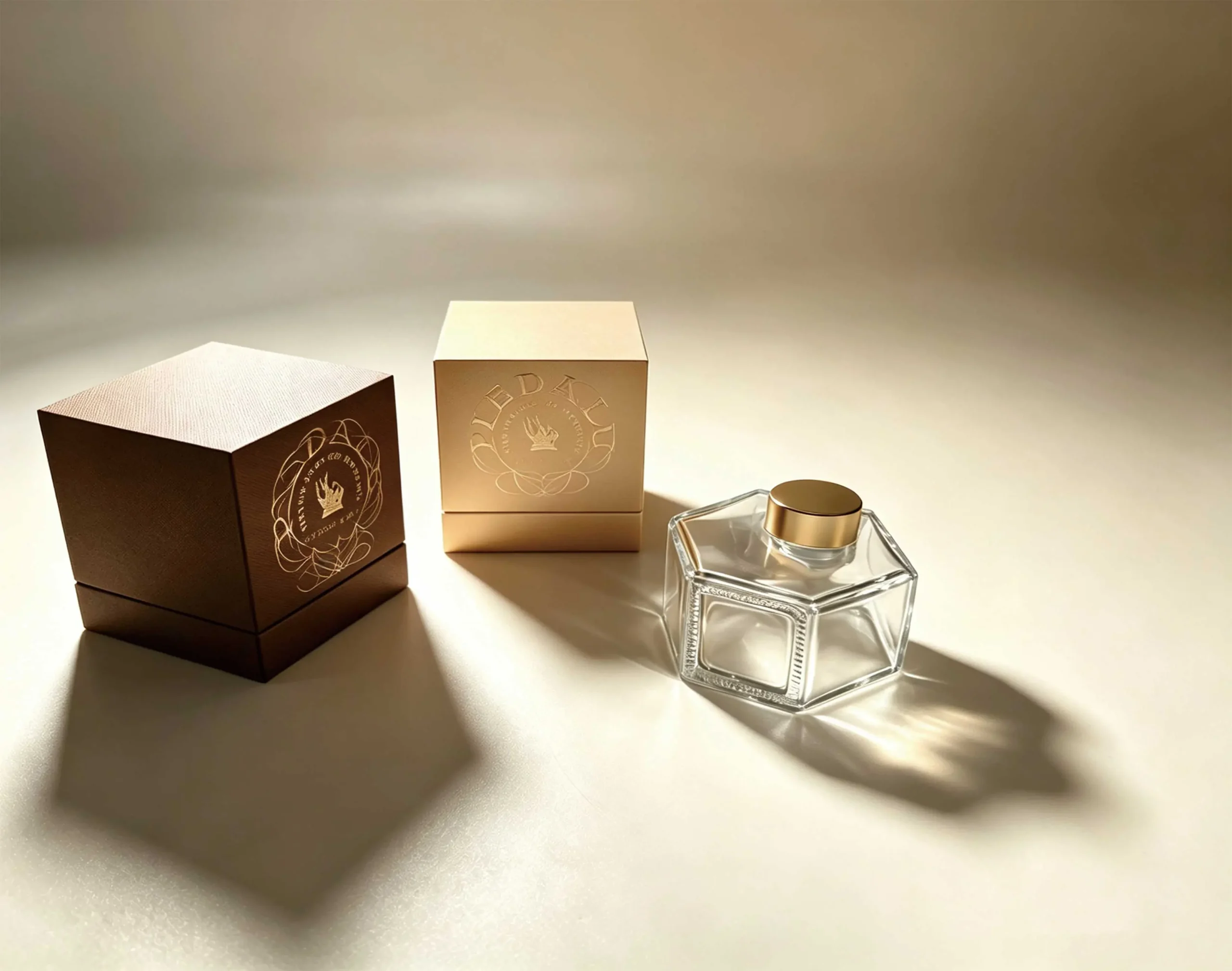
Few products are judged as quickly as fragrance. A shopper has already formed an opinion about your brand before the cap is lifted, because the box is the first thing their hands touch. That is why getting custom perfume boxes right — not just attractive, but engineered — is one of the highest-leverage decisions a fragrance brand makes. This guide walks through the entire 2026 process: choosing the bottle, selecting the box structure, specifying the insert, matching bottle-to-box dimensions, controlling cost across order volumes, and passing compliance and transit testing.
It is written for founders and packaging managers who are sourcing custom perfume packaging for the first time, and for established labels re-engineering a range for a refill or a new capacity. Every number in this article — MOQ, sampling time, board weights, glass grades and test values — is the figure YiZhou Packaging actually runs to, so you can brief a supplier with the same vocabulary we use.
⚡ Quick Answer
Custom perfume boxes are rigid or folding paper packages built around a specific bottle, not a generic size. A standard programme runs: bottle chosen from 10–100 ml stock or a custom mould, box structure selected (magnetic, drawer, lid-and-base, paper card or trial), an insert die-cut to the real bottle, a printed proof and physical sample in 3–7 days, then mass production, typically 8–12 business days, to an MOQ of 500 pieces. Every bottle-and-box set is leak-tested at −0.06 MPa for 5 minutes and drop-tested before shipment.
1. Why Custom Perfume Boxes Matter More Than Ever in 2026
Perfume is an emotional purchase wrapped in a physical one, and the box carries both jobs. It has to survive a courier network and it has to justify a premium price on a beauty counter. In 2026 that balance has tightened for three reasons.
- E-commerce is now the default channel. A growing share of fragrance is bought online and never handled before purchase, so the box must photograph well and protect a fragile glass bottle across thousands of kilometres.
- Refill and reframe economics. Durable outer packaging that survives repeated use lets brands sell a refill instead of a whole new product, which raises the value of a well-engineered shell and a precise insert.
- Sustainability expectations are now procurement requirements. Buyers ask for FSC®-certified board, recyclable paper trays and soy-based inks by name, and a supplier who cannot document these loses the brief.
For a deeper look at how box structure changes the perceived value of a fragrance, see our guide to picking the best custom perfume boxes for your branding.
2. The Four Layers of a Custom Perfume Packaging System
Experienced buyers think of perfume packaging as a stack of four decisions, made in order. Change one layer and the layers above it have to change with it.
- The bottle — capacity, glass grade, base weight, neck standard and cap. This defines the object everything else must hold.
- The box structure — how the box opens and how it ships: rigid magnetic, drawer, lid-and-base, folding paper card or trial format.
- The insert — the internal cradle that locates the bottle and absorbs impact: EVA foam, flocked EVA, blister, moulded pulp or a die-cut paper tray.
- The finish — printing, lamination, foil, embossing and any decoration that carries the brand identity.
Decide the bottle first, because the box cavity, the insert and even the board weight all follow from the bottle’s measured dimensions and mass. Our custom glass perfume bottles are catalogued by capacity, shoulder and base so a box cavity can be cut to the real bottle rather than a drawing.
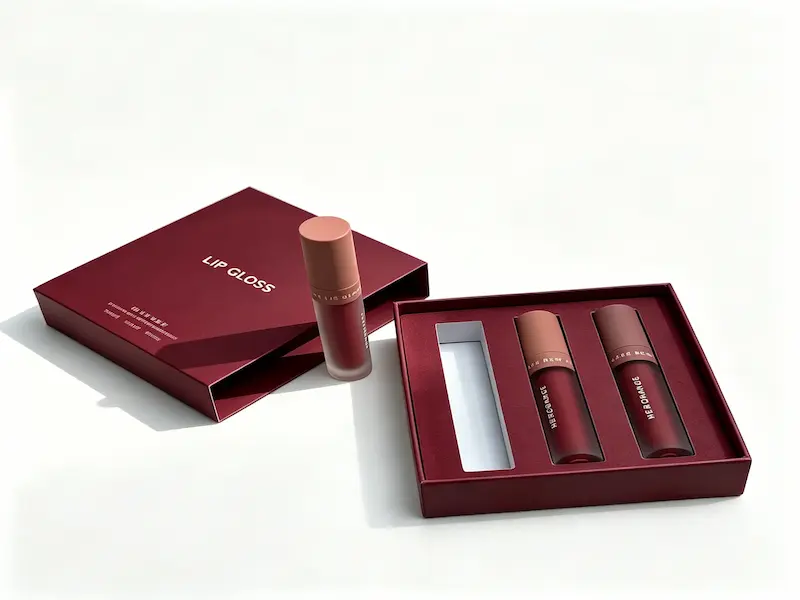
3. Perfume Bottle Selection: Capacity, Glass and Neck
Everything downstream is set by the bottle. Three parameters drive the packaging more than any other.
3.1 Capacity and the size ladder
Fine fragrance clusters around a predictable size ladder: 10 ml and 15 ml for purse sprays and discovery, 30 ml for the entry hero SKU, 50 ml as the volume leader, and 100 ml for the signature refillable. A range that shares one neck and one cap can add a size without re-tooling the box from scratch — only the cavity height changes.
3.2 Glass grade and base weight
The clearest premium signal is glass clarity and base mass. Super Flint — an extra-clear, low-iron formulation — transmits more light than standard flint, so pale and amber juices glow on shelf, and it is easy to form with a thickened, weighted base that gives the bottle a reassuring hand-feel. Our flagship YZ-B014 100 ml bottle is produced from high-clarity Super Flint with a thickened weighted base for exactly this reason, and the compact YZ-B013 carries the same glass specification in a 50 ml format.
3.3 Neck standard and pump
Specify FEA15, the 15 mm industry-standard crimp neck and collar. It is the de facto interface for fine fragrance and it lets you switch pump suppliers or dosage — 50 mcl, 70 mcl or 100 mcl — without touching the glass mould. A bottle that is serviceable for years after launch is a bottle that stays in your range.
| Bottle Parameter | Common 2026 Choice | Why It Matters to the Box |
|---|---|---|
| Capacity | 10 / 15 / 30 / 50 / 100 ml | Sets cavity height and the box’s internal footprint |
| Glass grade | Super Flint, extra-clear, low-iron | Perceived value; visibility through a window or open box |
| Base weight | Thick, solid weighted foot | Bottle mass determines the board weight and insert choice |
| Neck standard | FEA15 crimp neck + collar | Pump interchangeability without re-moulding the glass |
| Cap | Anodised aluminium, zamak or wood; often magnetic | Cap height above the shoulder adds to total box height |
| Decoration | Screen print, hot stamping, engraving, gradient coat | Determines the matching print and finish on the box |
To browse by size and silhouette, start from our full glass perfume bottles catalogue.
4. Perfume Box Structures: Matching the Opening to the Price
The box structure is the choreography of unboxing. It also decides freight volume and cost, because some structures ship assembled and some ship flat. The five structures below cover almost every fragrance brief.
4.1 Magnetic closure rigid box
A rigid shell built from 1200–1800 gsm grey board wrapped in printed paper and closed by hidden neodymium magnets, for a flush, book-style snap. It is the premium default for gift sets and hero SKUs. See custom magnetic boxes for board weights, magnet grades and closure types.
4.2 Drawer (slide-out) box
A rigid box with a sliding inner tray, opened by a ribbon or thumb cut. The horizontal pull creates a distinct reveal ritual and suits premium collections and travel sets. Full specifications are on our custom drawer boxes page.
4.3 Lid and base (two-piece) box
A separate lid and base that lift apart. It feels the most ceremonial and reads as true luxury, which is why it is common for limited editions. Because it ships assembled it takes more freight volume than a folding box.
4.4 Folding paper card box (tuck-end carton)
A lightweight, cost-efficient carton in 300–400 gsm coated paperboard that ships flat and folds in seconds — the most economical structure at volume and ideal for the mass retail shelf. See custom paper card boxes for gsm options and finishing.
4.5 Trial and sample box
Small-format folding boxes for 1.5 ml sprays, 2 ml vials and discovery sets. They let a new scent travel cheaply and hand the customer over to the full-size bottle. Explore trial perfume boxes for vial formats and tray options.
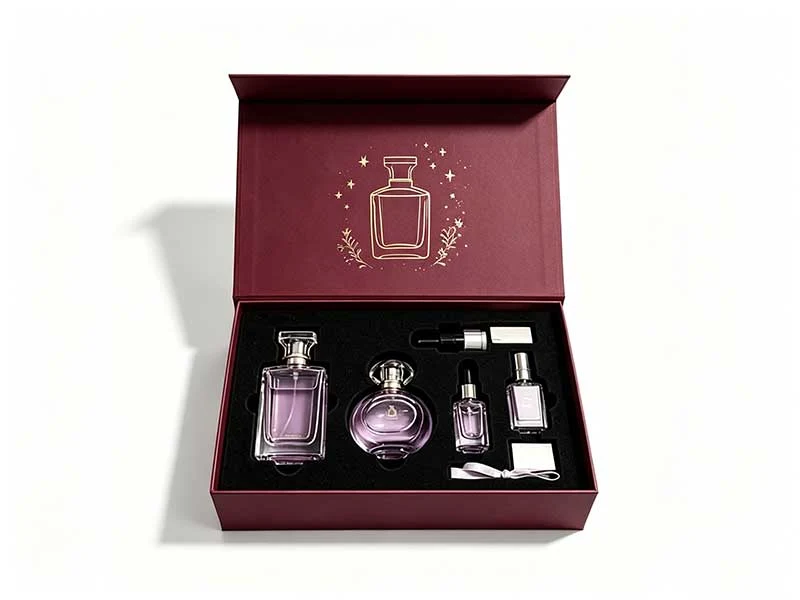
| Structure | Ships | Typical Board | Unit Cost | Best For |
|---|---|---|---|---|
| Magnetic rigid box | Assembled or flat | 1200–1800 gsm grey board + 157 gsm wrap | High | Gift sets, hero SKUs, press kits |
| Drawer / slide box | Assembled | 1200 gsm grey board + rigid tray | High | Premium collections, travel sets |
| Lid and base box | Assembled | 1200–1500 gsm grey board | High | Limited editions, ceremony |
| Paper card box (tuck-end) | Flat | 300–400 gsm coated paperboard | Low | Retail shelf, volume runs |
| Trial / sample box | Flat | 350 gsm coated paperboard | Lowest | Vials, discovery campaigns |
Whichever structure you choose, the range is unified under our custom perfume packaging boxes programme, so a brand can run a rigid hero box and a folding trial carton from one supplier.
5. Choosing the Perfume Box Insert: EVA Flocking, Blister, Pulp or Paper Tray
The insert is the least glamorous component and the one most responsible for whether bottles arrive intact. It has two jobs: locate the bottle so it cannot slide, and absorb the energy of a drop so the glass never takes the hit directly. There are five mainstream options.
5.1 EVA foam and flocked EVA
Closed-cell EVA foam, die-cut or CNC-milled to the bottle profile and often lined with a soft flocked surface. Flocked EVA is the premium choice for rigid gift boxes because it cradles the bottle, hides the cut edges and gives the interior a velvet hand-feel. It is the best option for heavy 50 ml and 100 ml flacons.
5.2 Blister (PET/PVC) tray
A vacuum-formed clear blister matched to the bottle, commonly used with a printed card or inside a folding carton. Highly repeatable and economical at volume, and it makes the bottle visible through a window. Best for retail boxes that need a locked, display-ready position.
5.3 Moulded pulp
A recyclable, plastic-free tray moulded from recycled paper pulp. It is the sustainability-forward option and is increasingly requested by brands with eco-positioning. Tooling is required, so it suits established volume rather than trial runs.
5.4 Die-cut paper tray / paperboard cradle
A folded or die-cut card cradle that holds the bottle with no plastic at all. It is the lightest and most recyclable insert and pairs naturally with a folding paper card box for a fully paper-based pack.
5.5 Satin-lined tray
A rigid tray lined with satin or suede-finish fabric for the top-tier gift box. The lining is applied by hand, so it is the most costly insert and is reserved for hero SKUs and press kits.
| Insert Type | Protection | Recyclability | Relative Cost | Best Paired With |
|---|---|---|---|---|
| Flocked EVA | Excellent | Low | High | Magnetic rigid box |
| Blister (PET/PVC) | Very good | Low–medium | Medium | Folding carton with window |
| Moulded pulp | Good | High | Medium–high (tooling) | Magnetic or lid-and-base box |
| Die-cut paper tray | Good | High | Low | Paper card box |
| Satin-lined tray | Excellent | Low | Highest | Lid-and-base gift box |
Bottle-and-box sets are the fastest route to a matched pack. Our magnetic box and bottle set pairs a rigid magnetic shell with a specific bottle and its pump cavity, while the paper card box and bottle set does the same in a folding format for retail and travel.
6. Bottle-to-Box Dimensional Matching and Tolerance
The single biggest reason a perfume box fails is that it was designed against a nominal bottle size rather than the real, measured one. Glass is manufactured to a tolerance, board has thickness, and the insert has a wall — all three have to be accounted for. The rule is simple: the cavity equals the measured bottle plus the insert wall plus a working clearance, and clearance is deliberately kept small so the bottle never rattles.
| Dimension | Working Value | Note |
|---|---|---|
| Glass body tolerance | ±0.5 mm | Measure the actual bottle, not the catalogue figure |
| Insert cavity vs. bottle | Bottle + 0.5–1.0 mm per side | Snug fit that stops movement without stressing the glass |
| Box interior vs. insert | Insert + 0.5 mm clearance | Allows the insert to drop in during assembly |
| Board thickness (rigid) | 2.0–3.0 mm | 1200–1800 gsm grey board |
| Headroom above cap | Bottle + cap + 2–3 mm | Prevents the cap pressing the lid, which bows it over time |
| Finger/ribbon pull allowance | 12–15 mm | Cosmetic allowance for drawer and lift-out structures |
7. MOQ and the Cost Ladder: How Order Volume Changes Unit Price
Because rigid boxes are cut, wrapped and assembled largely by hand, the unit cost falls steeply with volume and then flattens. The drivers are fixed: tooling and die-boards are amortised across the run, print set-up is a one-time cost per colourway, and material is bought at tiered prices. Our standard programme starts at an MOQ of 500 pieces, with low-MOQ trial runs available for startups.
The table below shows how a structure’s relative unit cost index typically behaves across order bands. Treat it as a planning model, not a quotation — the absolute figure depends on size, board weight, finishing and insert.
| Order Band | Relative Unit Cost Index | What Changes |
|---|---|---|
| 500 pcs (MOQ) | 100% (baseline) | Tooling and print set-up carried by the smallest run |
| 1,000–2,999 pcs | ~80–88% | Set-up cost spread; material tiering begins |
| 3,000–4,999 pcs | ~70–78% | Better board and magnet pricing; more efficient cutting |
| 5,000+ pcs | ~60–70% | Best material tiers; continuous run lowers handling cost |
Three levers cut cost without hurting perceived quality: keep one board weight across the range, share one print colourway between the hero box and the carton, and choose a folding structure where the product ships flat. The biggest lever of all is committing to a single neck, cap and box footprint across the whole size ladder so a 30 ml, 50 ml and 100 ml all share tooling.
8. Compliance and Transit Testing Before You Ship
A fragrance product crosses borders and courier networks, so packaging has to clear both regulatory and physical hurdles. Build these checks into the sampling stage rather than discovering them after the run.
8.1 Leak and seal integrity
Every bottle-and-box set is checked with an airtight anti-leak vacuum test at −0.06 MPa held for 5 minutes as a pass criterion, so a faulty pump seal or neck fit is caught before it wets a paper box in transit.
8.2 Drop and vibration testing
Packed cartons are drop-tested and vibration-tested to simulate parcel handling. The insert is what makes or breaks the result: a bottle that shifts even 5 mm inside the cavity can crack on the second impact.
8.3 Materials and regulatory compliance
Specify FSC®-certified board, soy-based inks and water-based coatings, and ask for the chain-of-custody certificate. Our paper packaging factory, Jinglin Packaging, is FSC® certified (FSC-C179946), and non-toxic inks and adhesives are standard for direct-contact and near-contact packaging.
| Test / Requirement | Standard Used | Why It Matters |
|---|---|---|
| Airtight anti-leak | −0.06 MPa vacuum held 5 minutes (pass) | Prevents leakage that ruins the box and the brand experience |
| Drop test | Parcel-handling drop simulation | Confirms the insert locks the bottle on impact |
| Vibration test | Transit vibration simulation | Detects abrasion and label damage over long freight |
| Board certification | FSC® Chain of Custody (FSC-C179946) | Meets EU and US sustainable-packaging procurement |
| Inks and adhesives | Soy-based ink, water-based coating | Reduces migration risk for fragrance packaging |
9. From Zero to One: A 7-Step Process for Your First Custom Perfume Boxes
If you are launching a fragrance brand, the following sequence turns the theory above into a purchase order. Each step has a concrete output you can hold or sign off.
- Define the product. Choose capacity, glass grade and neck. Output: a bottle specification with the cap and pump fitted.
- Choose the box structure. Magnetic, drawer, lid-and-base, paper card or trial, matched to price point and channel. Output: a structure decision and a target board weight.
- Specify the insert. Flocked EVA, blister, pulp or paper tray, matched to bottle weight. Output: an insert material and a drawing of the cavity.
- Confirm the decoration. Printing method, lamination, foil and embossing. Output: print-ready artwork and a colourproof.
- Approve a physical sample. Pre-production samples in the real glass, cap and board are typically ready within 3–7 days. Output: a signed sample and a locked specification.
- Run mass production. Standard mass production runs about 8–12 business days after sample approval, followed by leak and drop testing. Output: production cartons ready to ship.
- Ship and reorder. Express, air or sea freight, with outers and dividers for bulk. Output: a repeatable specification for your next size.
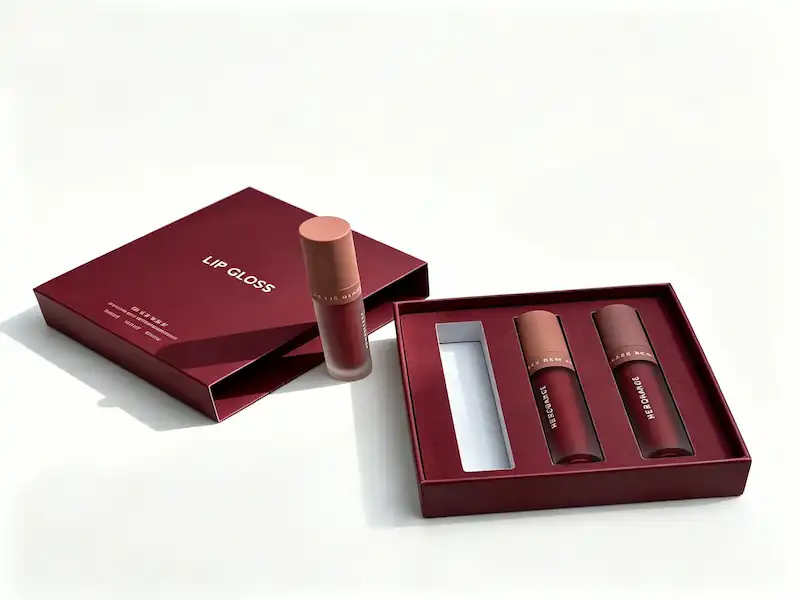
At YiZhou Packaging the glass bottles and the paper packaging are manufactured in-house, so a bottle concept and its box, insert and finish are developed as one unit rather than assembled from two suppliers’ catalogues. Our team provides structural drawings, 3D mockups and pre-production samples, giving fragrance brands one partner from the first silhouette sketch to the final inspection.
Frequently Asked Questions
Our MOQ for custom perfume boxes is 500 pieces, with small trial runs also available for startups. Custom glass bottles are moulded from 5,000 pieces, while stock bottles start from 500 pieces, so a launch can begin with a stock bottle and a fully custom box.
Pre-production samples in the final glass, cap and board are normally ready within 3–7 days. Mass production typically takes about 8–12 business days after sample approval, followed by leak and transit testing before shipment.
We design the box against the measured bottle with the cap and pump fitted, not a catalogue figure. The cavity equals the bottle plus the insert wall plus a small working clearance (about 0.5–1.0 mm per side), and we always approve a physical sample containing the real bottle before the run.
Rigid magnetic and drawer boxes suit hero SKUs and gift sets, lid-and-base boxes suit limited editions, and folding paper card boxes are the most economical for retail volume. Trial boxes handle samples and vials. The right choice depends on your price point and channel.
For heavy 50 ml and 100 ml bottles, flocked EVA foam gives the best protection and a velvet interior. A PET blister is ideal for a windowed retail carton, moulded pulp and die-cut paper trays are the recyclable options, and a satin-lined tray is reserved for top-tier gift boxes.
Every bottle-and-box set passes an airtight anti-leak vacuum test at −0.06 MPa held for 5 minutes, alongside drop and vibration testing that simulates parcel handling. Board can be supplied FSC®-certified (FSC-C179946) with soy-based inks and water-based coatings for EU and US packaging compliance.