Perfume Sample Packaging: The Complete Guide to Sample Boxes, Vials and Sizes
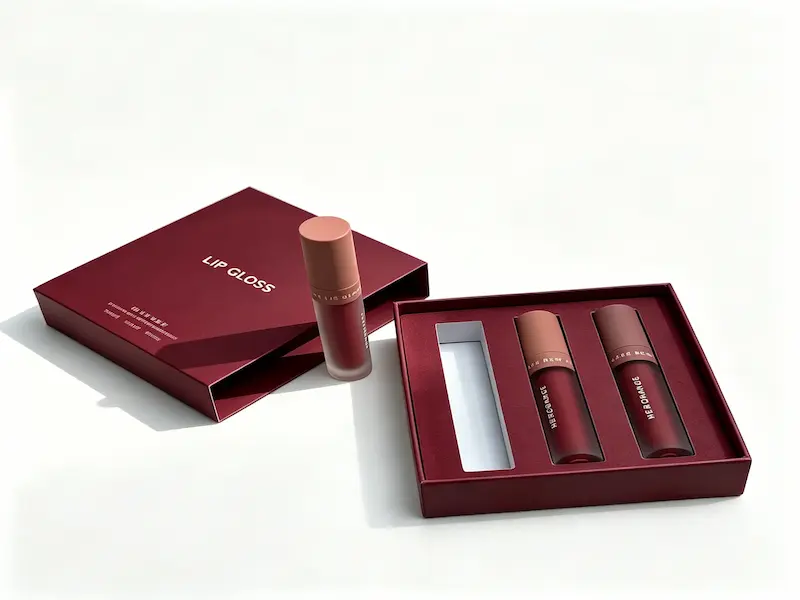
Perfume sample packaging is the quiet workhorse of fragrance marketing: a well-built trial box lets a customer try a scent with almost no risk, while carrying your brand into a handbag, a bathroom shelf or a gift bag. For indie perfumers and established houses alike it is often the first physical touchpoint a new customer has with the brand — which is why the structure, the capacity and the graphics of sample size packaging deserve as much attention as the juice inside.
This guide is the reference page for the whole sample and discovery format: how to match a box to a 1 ml vial versus a 10 ml travel spray, how to stop fragile glass breaking in transit, which boards and inserts actually work at sample scale, what drives cost and minimum order quantity, and what to check before you place the order. Each section links to the more detailed guides where a topic needs its own space.
The short answer
Sample packaging is sized by the format, not by the scent. A 1–2 ml vial or carded spray needs only a slim folding sleeve; a 5–10 ml travel spray needs a real base and an insert (typically 300–350 gsm board, or 400 gsm / rigid greyboard for multi-vial sets); a three- or five-vial discovery set becomes a rigid box with a moulded or EVA tray. Leave 1.5–2 mm clearance around the glass so the insert absorbs impact. MOQ for folding trial cartons typically starts around 500–1,000 pieces, rigid discovery boxes around 300–500.
1. What “sample size packaging” actually covers
The phrase covers five quite different products, and mixing them up is the most common source of a failed sample programme. Before choosing a box, decide which of these you are actually shipping:
- Glass vials (1–2 ml) — the classic fragrance sample. A small glass tube with a crimped or screw cap, usually presented in a card sleeve, a die-cut card or a blister card.
- Carded sprays — a vial or miniature atomiser mounted on a printed card, designed to hang on a pegboard or sit in a counter tray. Cheap to produce, cheap to post.
- Travel sprays and rollerballs (5–10 ml) — a real bottle in miniature, with a sprayer or rollerball and a cap. Heavy enough that the box needs a base and an insert.
- Miniatures (5–15 ml) — a scaled-down version of the retail flacon, often used as a gift-with-purchase or a travel retail SKU.
- Discovery and gift sets (3–10 pieces) — a curated collection in a rigid box with a divided tray. This is where sample packaging stops being a giveaway and becomes a sellable SKU in its own right.
The format decides the box far more than the juice does. A brand moving from vials to a discovery set is not making a packaging tweak — it is moving from a 5-cent folding sleeve to a rigid box with a moulded tray, hand assembly and a completely different cost structure.
2. Sample size packaging guide: format, box and board weight
Use this table to fix the format first, then design the box around it. Board weights are the ones that hold up in practice; anything lighter tends to dent in the post.
| Format | Capacity | Box type | Typical board / construction | Where it is used |
|---|---|---|---|---|
| Glass vial | 1–2 ml | Die-cut card or slim tuck sleeve | 300–350 gsm solid board | Press kits, counter trays, magazine inserts |
| Carded spray | 1.5–3 ml | Printed card with blister or fold-lock | 300–350 gsm, single-side print | Retail pegboard, subscription boxes |
| Travel spray | 5–10 ml | Tuck-end carton with folded shelf | 350 gsm solid board | E-commerce samples, travel retail |
| Rollerball | 5–10 ml | Tuck-end carton, wider throat opening | 350–400 gsm | Discovery, gift-with-purchase |
| Miniature flacon | 5–15 ml | Rigid two-piece or folding carton | Rigid greyboard core + wrap | Gift sets, holiday editions |
| Discovery set | 3–5 vials | Rigid magnetic or drawer box | Rigid greyboard + divided tray | Direct-to-consumer sets, retail SKUs |
| Deluxe discovery set | 5–10 pieces | Rigid book-style or drawer box | Rigid greyboard + EVA foam tray | Premium gifting, limited editions |
Board weights are practical starting points for fragrance samples, not absolutes — a heavier vial or a longer postal route moves you up a row.
Two details catch people out at this stage. Rollerballs need a slightly wider throat opening than sprays of the same capacity, because the cap has a larger diameter and catches on the board if the cut-out is sized for a spray. And a vial diameter is not a standard — two “2 ml” vials from different suppliers can differ by half a millimetre, which is the difference between a snug insert and a loose one.
How to measure a vial for a sample box
You need four numbers, and three of them are not on the catalogue page. Measure with a digital caliper on the vial you will actually use:
- Body diameter at the widest point of the glass — not at the shoulder, and not including the cap.
- Total height with the closure fitted, because a crimp cap and a screw cap of the same vial differ in height.
- Cap or collar diameter, which sets the throat opening of the insert or the fold-lock on a card.
- Weight filled, which decides whether a folding shelf is enough or you need foam.
Add 1.5–2 mm of clearance per side and you have your cavity. If you are ordering glass at the same time as boxes, measure a pre-production sample rather than a stock photo — a fraction of a millimetre here is the difference between a box that presents well and one that rattles.
3. Why sample packaging wins customers
Selling fragrance is an emotional sale, and a sample removes the barrier that stops most first-time buyers. A well-designed sample box does more than hold a vial — it earns the right to be kept, photographed and passed on.
- It lowers the cost of trial so a customer can experience the scent before committing to a full bottle.
- It extends reach through counter trays, subscription boxes, hotel amenities and gift-with-purchase programmes.
- It feeds discovery sets by turning three or five vials into a curated, giftable collection.
- It reduces leakage and breakage claims with fitted inserts that stop glass knocking together in transit.
- It creates social content — a neat sample box is one of the most photographed pieces of fragrance packaging in reviews.
Because a sample box is inexpensive relative to the marketing value it delivers, it is one of the highest-leverage pieces of packaging a fragrance brand can invest in. The catch is that the margin for error is small: at sample scale, a badly fitted insert or a print that smudges reads as carelessness rather than economy.
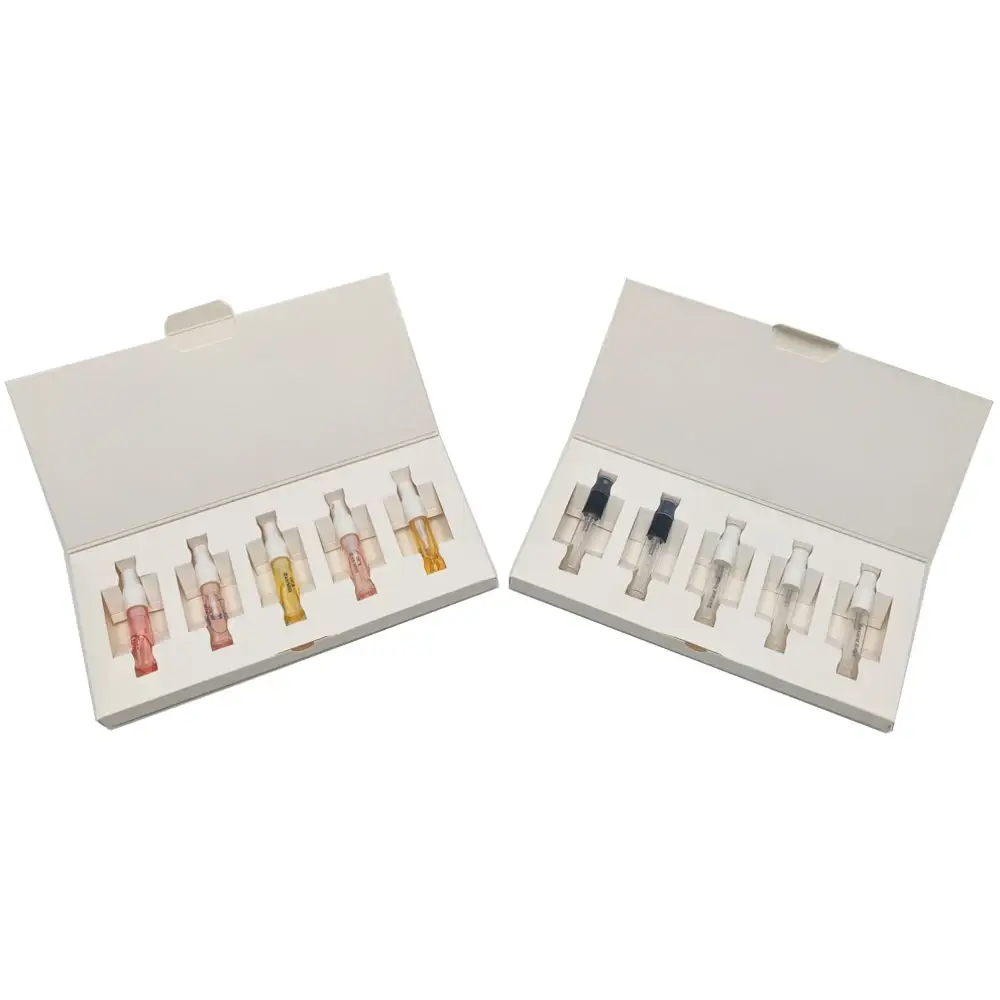
A 10 ml trial box: the folded shelf does the work, and the print stays out of the impact path.
4. Protecting glass: insert options compared
Glass is unforgiving. A cracked vial or a stained box is a structural failure, not a printing failure — so design the inside of the box before the outside.
| Insert type | Protection | Cost tier | Recyclability | Best for |
|---|---|---|---|---|
| Die-cut paperboard tray | Good for single vials | Lowest | Paper stream | Slim sleeves, single-vial cartons |
| Folded card shelf | Good — locks the body in place | Low | Paper stream | 10 ml travel sprays |
| EVA or PE foam | Best shock absorption | Highest | Generally not recyclable | Premium sets, heavy miniatures |
| Moulded pulp tray | Very good, rigid | Medium | Compostable / paper | Clean-beauty and botanical lines |
| Cardboard cross dividers | Separates, does not cushion | Low | Paper stream | Multi-vial sets so glass never touches glass |
Whatever the insert, leave 1.5–2 mm of clearance between the vial and the box wall so the insert — not the print — takes the impact. For multi-vial sets, dividers are not optional: two glass vials touching in transit will chip, and a chipped vial in a discovery set is worse than a missing one.
Folding trial boxes are usually fine at 300–350 gsm for a single vial. Step up to 400 gsm, or a rigid greyboard core, when the box holds multiple bottles or has to survive international freight and repeated handling. Our custom trial perfume boxes are built around the vial dimensions rather than a generic cavity, which removes most of the guesswork from fit testing.
5. Materials and finishes at sample scale
A sample box is small, so the material cost per unit is low — which means you can afford a finish that would be too expensive on a full-size carton. That asymmetry is the main creative advantage of sample packaging.
| Material | What it gives you | Watch out for |
|---|---|---|
| White card (FBB / SBS) | Bright, smooth, ideal for fine type and scent notes | Shows scuffs; laminate for durability |
| Kraft board | Natural, unbleached, fits artisan brands | Colour shifts between batches; limited bright print |
| Textured / soft-touch paper | Tactile luxury on a very small object | Soft-touch films can mark with oils from fingers |
| Rigid greyboard + wrap | Substantial, giftable feel for discovery sets | Heavier to ship; higher MOQ |
On the finishing side: matte lamination resists fingerprints, spot UV highlights a logo on an otherwise flat field, and hot-foil stamping gives a metallic accent that reads clearly at sample scale. For most fragrance sample boxes the reliable combination is a matte-laminated 350 gsm board with one foil or emboss detail — restrained, durable and visibly better than a plain giveaway sleeve.
6. Designing sample packaging that converts
A sample only pays for itself if it drives a purchase. At this size the information layer is what turns a trial into a transaction.
- Keep the brand mark large. At sample size a small logo disappears — give it room and print it in one strong colour.
- Name the scent clearly — family, top notes and mood in two or three words, so the box also works as a shelf label.
- Add a QR code or short URL that leads straight to the matching full-size product page or a reorder form.
- Include usage guidance — where to apply, how many sprays, how long the vial lasts. It reduces waste and increases satisfaction.
- Print the batch number so runs stay traceable on a box that is often separated from the bottle.
- Leave a clean panel for retailer stickers so barcode and price labelling stays tidy on a counter display.
The most under-used element is the reorder path. A sample that carries a direct link to the full-size bottle converts far better than one that only carries the brand name and leaves the customer to search.
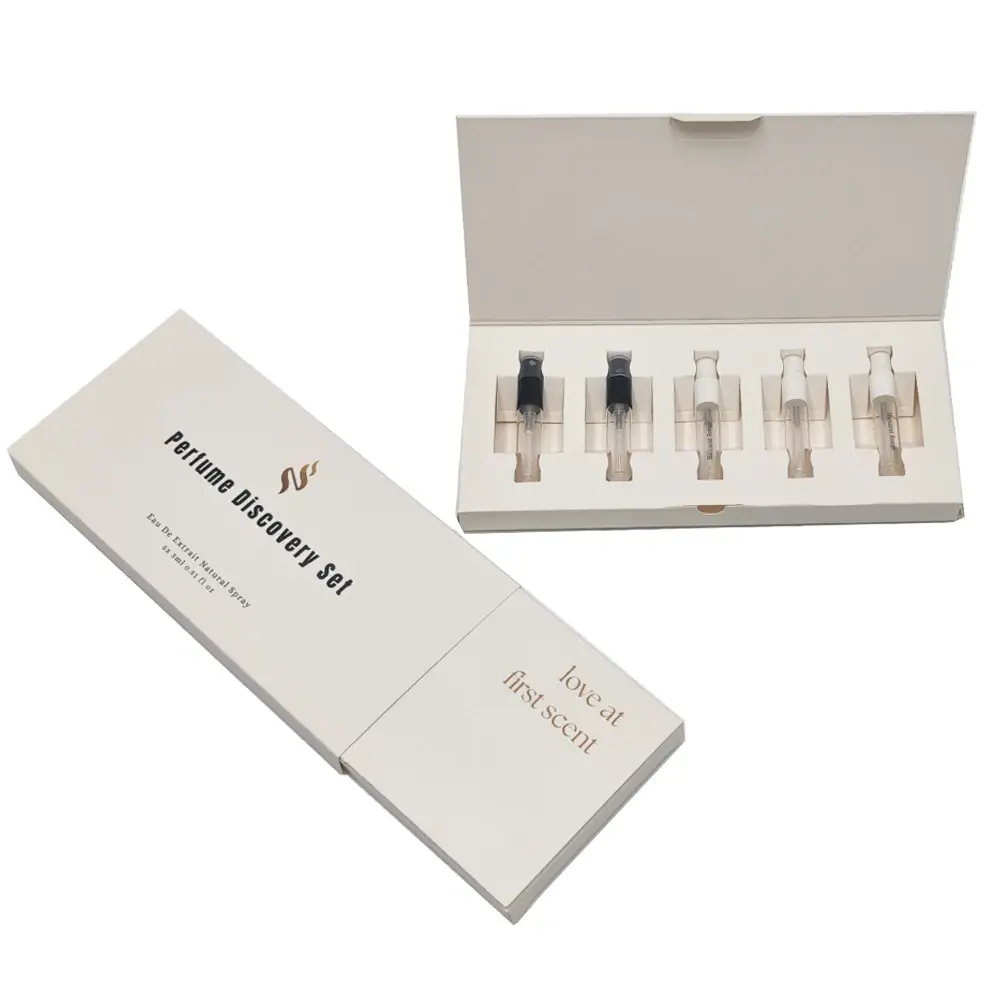
Every batch is checked for fit, print registration and insert integrity before it leaves the factory.
7. Sample packaging cost and minimum order quantity
Sample packaging is cheap by unit but expensive by set-up, and that ratio is what determines your real minimum order. Five things drive the cost:
| Cost driver | What moves it | How to control it |
|---|---|---|
| Structure and board | Folding carton vs rigid greyboard box | Start folding; move to rigid only for sets |
| Insert | Die-cut paper vs EVA foam vs moulded pulp | Paper tray for single vials; foam only where protection is critical |
| Print and finishing | Spot colour count, foil, emboss, soft-touch | One foil or emboss detail reads as premium; more rarely pays back |
| Hand assembly | Rigid boxes and multi-vial trays are hand-built | Simplify the tray; reduce the number of components |
| Order quantity | Set-up cost (dies, plates, make-ready) is fixed | Consolidate formats; use one box across several scents |
On quantity: folding trial cartons and slim sleeves typically start around 500–1,000 pieces, while rigid discovery-set boxes usually start at 300–500. Digital printing can support smaller test runs than offset, at a higher unit cost — which is often the right trade for a first campaign before you commit to a seasonal volume.
The single biggest cost mistake is designing a different box for every scent. One structure, one print run, several SKUs differentiated by a sticker or a one-colour overprint, will cost a fraction of five separate boxes.
8. Sourcing custom perfume sample boxes
Sample runs are small, which makes supplier selection more important rather than less — a 500-piece order has no room for a second tooling round.
- Fragrance-specific experience — a supplier who already knows vial sizes and insert tolerances gets the fit right first time.
- In-house structure, print and finishing — one partner handling dies, printing and lamination shortens the loop between artwork and a finished box.
- A physical prototype before production — always ask for a pre-production proof in the final material, tested with a real vial.
- Realistic minimums and lead times — confirm the MOQ and production window actually suit a seasonal campaign.
- Bottle-and-box pairing — buying vials and boxes from one source removes the risk of a glass-to-insert misfit.
At YiZhou Packaging the glass bottles and the paper packaging are manufactured in-house, so a sample box is designed around the actual vial it will hold rather than a nominal size. That removes the most common cause of a failed first sample round: a box that fits the drawing but not the glass.
9. Five mistakes that ruin a sample programme
Most failed sample runs fail for the same five reasons. All of them are decisions made before the artwork is finished.
| Mistake | What actually happens | Fix |
|---|---|---|
| Sizing the box from a catalogue vial | The insert is loose or the vial will not seat; the first sample round fails | Measure the real vial with calipers before drawing the die |
| No clearance around the glass | Vials chip in transit; the insert cannot absorb anything because it is already tight | Design 1.5–2 mm per side and let the insert take the load |
| One box design per scent | Five tooling and make-ready costs instead of one | One structure, several SKUs differentiated by sticker or one-colour overprint |
| Too many finishes on a small object | Cost climbs faster than perceived quality; foil on a 30 mm panel is hard to read | One foil or emboss detail, matte lamination, generous brand mark |
| No reorder path on the box | The customer tries the scent, then has to search for the full bottle — many do not | Add a QR code or short URL straight to the matching product page |
The last one is the most expensive because it is invisible. Every other mistake shows up as a defective unit; a missing reorder path shows up as a sample that was liked and never acted on.
10. Related guides in this series
Sample and trial packaging connects to several other decisions. These are the pages that go deeper:
| If you need to know… | Read this |
|---|---|
| Which crimp or screw finish a sample vial uses, and how to measure it | Perfume bottle neck sizes and crimp specifications |
| How to make sample packaging stand out on a crowded counter | Innovative sample packaging ideas |
| Magnet grade, board weight and lid tolerance for discovery-set boxes | Magnetic perfume boxes: construction and tolerance |
| Trial and sample box structures, product detail | Custom trial perfume boxes |
| Carded sample format for vials | Perfume trial packaging card |
| Matching a box structure to a bottle in a set | Paper card box and bottle sets |
| The full glass bottle range and finishes | Glass perfume bottles |
| All rigid and folding box structures | Custom perfume boxes |
Frequently Asked Questions
It depends on the structure. Slim card sleeves and folding trial cartons typically start around 500–1,000 pieces, while rigid discovery-set boxes usually start at 300–500. Digital printing can support smaller test runs, though the unit cost is higher.
Fit an insert that holds the vial body — a die-cut paperboard tray, EVA foam block or moulded pulp tray — and leave 1.5–2 mm of clearance so the insert absorbs shock instead of the glass. For multi-vial sets, add dividers so bottles never touch each other.
For a single 10 ml travel spray, 350 gsm solid board with a folded shelf is a good balance of strength and cost. If the box holds several bottles or ships internationally, move to 400 gsm or a rigid greyboard core.
Sample size packaging is the individual unit — a vial, carded spray or travel spray in its own sleeve or carton. A discovery set is a multi-piece collection in one rigid box with a divided tray, which is a sellable SKU rather than a giveaway. The same glass formats can appear in both.
Yes, and they should. Pantone spot colours, the same paper stock and the same finishing — matte lamination, foil or emboss — can be carried across the sample box and the full-size carton so the range looks like one family.
Yes. We manufacture glass bottles and paper packaging in-house, which means the sample box and insert are engineered around the exact vial dimensions. Our design team also assists with structural drawings, 3D mockups and print-ready artwork.